Stress and Overthinking
Dr. Smitha's guides and coaching for an anxious, always-on mind.

Stress and overthinking · Online and in the UAE
High functioning anxiety, as Dr. Smitha Prabhakar sees it in leaders, means looking calm and capable on the outside while feeling constantly on alert inside.
On the outside: composed, capable, always delivering.
On the inside: always on.
It is an informal term, not a diagnosis, and this guide is part of Dr. Smitha's Stress and Overthinking pages for an anxious, always-on mind.

“The power is in the pause.”
Clear decisions start with a calm mind
High-functioning anxiety is an informal name for anxiety that hides behind high performance, and leaders tend to cope best by building recovery into the day and getting support early.
Cleveland Clinic psychologist Adam Borland describes it as feeling anxious while still seeming able to manage the demands of daily life (Cleveland Clinic).
The same article says it cannot be diagnosed, and that people with it often push themselves to work harder to fight the anxiety.
It is not the same as generalised anxiety disorder, which the NHS describes as worry that affects your daily life and is hard to control (NHS).
The two can overlap, and only a doctor or psychologist can tell which applies to you.
Many leaders describe themselves to Dr. Smitha in almost the same words: successful on paper, always on underneath.
These are the patterns she hears most often:
Cleveland Clinic adds perfectionism, overthinking, needing reassurance, finding it hard to say no and jumping to the worst case.
From the outside these people often look like the most reliable person on the team.
That is exactly why it can go on for years before anyone, including them, names it.

Somatic simply means "of the body", and for many high performers the body is where anxiety shows first.
The NHS lists physical symptoms of generalised anxiety disorder that include feeling tense, stomach problems, a noticeable or unusual heartbeat, feeling lightheaded and difficulty sleeping.
Stress can bring headaches, muscle tension and chest pain or a faster heartbeat too (NHS).
Every one of these can have other causes, so please see a doctor to check, and treat chest pain as urgent.
These are the habits Dr. Smitha builds with clients, alongside professional support when it is needed.
Breathe in for four and out for six, for about two minutes, before a board meeting or a difficult call.
The NHS describes a similar gentle breathing exercise for stress (NHS).
A short guided rest every day does more for an always-on mind than waiting for the next holiday.
Dr. Smitha's clients use The Deep Rest Reset, a 27-minute Full Reset and a 10-minute Short Reset.
Write decisions down and close what you can, so the mind is not carrying them all at once.
The How to Stop Overthinking guide sets out the steps.
Cleveland Clinic's psychologist stresses watching work-life balance and saying no without seeing it as weakness.
For many leaders that starts with a set time when the working day ends.
A coach, a trusted peer, or a doctor or therapist.
People with high-functioning anxiety can see asking for help as a sign of weakness, Cleveland Clinic notes, which is one more reason to ask early.
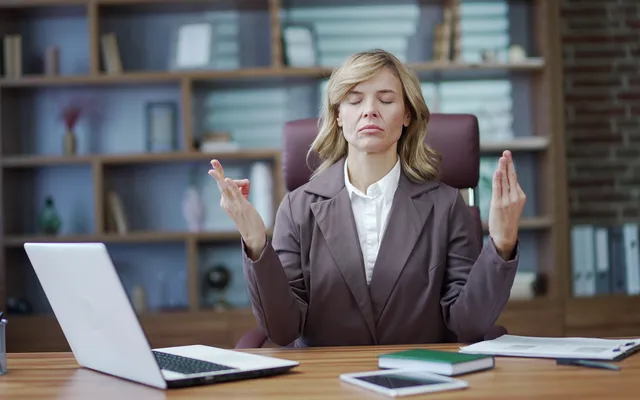
Mindfulness means paying attention to the present moment on purpose, and mindfulness for anxiety is one of the most studied areas of mind-body research.
The US National Center for Complementary and Integrative Health reports a 2018 analysis of more than 12,000 people with diagnosed anxiety or depression (NCCIH).
In it, mindfulness approaches did better than no treatment and about as well as established evidence-based options.
The same page notes a 2021 analysis with mixed results and unclear risk of bias, so the evidence is promising, not settled.
NCCIH also reports that about 8 percent of participants in one review had a negative experience with meditation, most often anxiety or low mood.
Dr. Smitha is trained as a master trainer in mindfulness and peak performance, and she keeps the practice short and practical.
If mindfulness meditation for anxiety makes you feel worse rather than steadier, stop and talk to a doctor or psychologist.
| Practice | Check with your doctor first if you... |
|---|---|
| Breathwork | are pregnant, have epilepsy, a heart condition, high or low blood pressure, or a panic disorder |
Dr. Smitha does not diagnose or treat anxiety, and her work is coaching, not therapy.
What she offers is support for an anxious, always-on mind: steadier attention, calmer evenings and recovery that fits a real calendar.
If she thinks someone needs clinical support more than coaching, she says so.
Stress and Anxiety Coaching explains how private sessions with Dr. Smitha work, and the nervous system regulation guides cover the body side in more depth.
Anxiety disorders are medical conditions, and the US National Institute of Mental Health notes that they can get worse over time if anxiety does not go away (NIMH).
See a doctor or psychologist if worry is hard to control, affects your work or relationships, or comes with poor sleep or appetite changes.
If you have chest pain, palpitations or feel faint, see a doctor promptly.
If you have thoughts of harming yourself, contact a doctor or emergency services now. In the UAE, call 999 for the police or 998 for an ambulance.
It is an informal term for people who appear calm and successful but feel constant worry underneath.
It is not a diagnosis, and a doctor or psychologist can assess anxiety properly.
Many use slow breathing before big moments, daily recovery, clearer limits around work and support from a coach, a peer or, when needed, a doctor or therapist.
Slow your breathing, move your body, rest a little every day, limit the news and talk to someone you trust.
If anxiety is frequent or hard to control, please see a doctor.
Separate what you can control from what you cannot, protect daily recovery and talk big decisions through with someone before acting on fear.
Dr. Smitha's guides and coaching for an anxious, always-on mind.
Five ways out of the loop, in the day and at night.
One-to-one coaching, online or in person in the UAE.
Why you cannot switch off at night, even when exhausted.
If you are in crisis in the UAE, call 999 for the police or 998 for an ambulance.
Dr. Smitha is a coach and wellness consultant, not a therapist or medical doctor, so her work is coaching, not therapy.
Contact
If you are composed on the outside and always on underneath, tell Dr. Smitha what that looks like for you and she will suggest a sensible first step.