Deep Rest
Dr. Smitha's overview of NSDR, yoga nidra and conscious deep rest.

Deep rest · Online and in the UAE
Dr. Smitha Prabhakar's answer to the best guided sleep meditation is simple: the one you will repeat, in a voice you like, with something gentle to follow.
You do not need a blank mind. You need a voice to follow.
This guide is part of Dr. Smitha's Deep Rest pages, written for people whose minds stay on shift after the laptop closes.
It covers what to look for, a short practice for the middle of the day, and where guided rest fits next to a full night's sleep.

“The power is in the pause.”
Clear decisions start with a calm mind
A guided meditation for sleep works when it gives your attention a path, so you are following rather than trying to force quiet.
Most people who say they cannot meditate have been told to empty their head. A busy mind does not go quiet on command.
A guided sleep meditation solves that by handing the mind a small, steady job: listen, notice, let go.
Apps, recordings and live sessions all meet these tests in different ways. Try a few, then keep the one you return to without arguing with yourself.
Research is promising but still early: the US National Center for Complementary and Integrative Health says mindfulness meditation may help improve sleep quality, and that much of the research has been preliminary (NCCIH).
In one randomised trial, older adults with moderate sleep problems who took a six-week mindfulness course reported better sleep quality than a group given sleep hygiene education (Black and colleagues, 2015).
That was a small study in one age group, and a course with homework, not a single recording.
So treat a guided meditation as one part of a calmer evening, not a fix.
The NHS advice for sleeping better includes relaxing for at least an hour before bed, for example with a bath or a book (NHS). A guided recording can be that hour's last ten minutes.
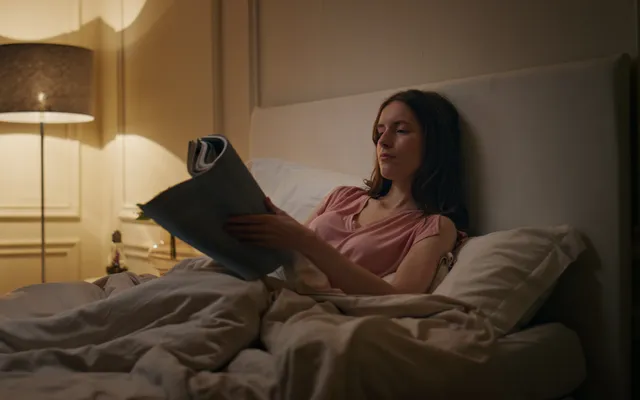
If you have never done this before, here is the shape most guided rest follows. Treat this guided meditation script as a map: read it once, then let a recording take over.
When your mind wanders, and it will, notice where it went and come back to the voice. That noticing is the practice.
A guided meditation for beginners free of charge is easy to find in apps and online, and Dr. Smitha's Short Reset is free to use as well.
For a longer body-based version, Dr. Smitha's body scan meditation guide goes step by step.
A good short audio for between meetings is about ten minutes long, needs only headphones and a chair, and asks nothing of you except to follow along.
That is why Dr. Smitha built the Short Reset in The Deep Rest Reset: 10 minutes, made for the middle of a full day.
For the end of the working day, the 27-minute Full Reset gives a longer wind-down.
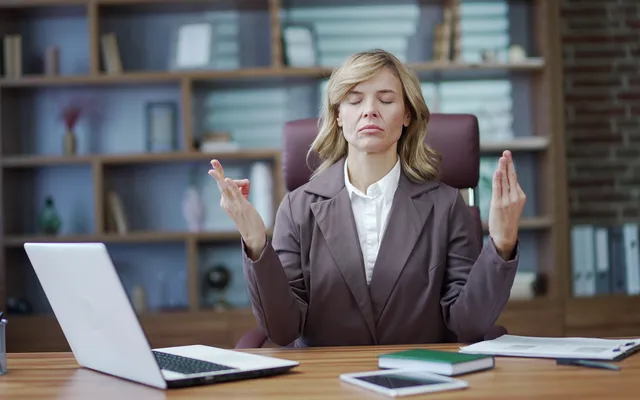
Dr. Smitha's PhD research is on conscious deep rest, and the people she works with are usually tired but still wired.
In her experience, the leaders who say they are bad at meditation are rarely bad at anything. They have simply been given the wrong instruction.
So she does not push meditation. She gives them a voice to follow and a length that fits a real calendar.
She tested deep rest on herself first, in a documented 100-day self-study. She treated it as an addition to sleep, never a substitute for it.
If an always-on mind is also showing up as a racing heart or a short fuse, her pages on nervous system regulation explain the wider picture.
For an anxious, always-on mind, a guided practice can be a gentle place to start, but it is not anxiety treatment.
NCCIH notes that few studies have looked for harmful effects, and one review found about 8 percent of participants had a negative effect, most often anxiety or depression (NCCIH).
If a recording leaves you more unsettled, stop, open your eyes and try something more active, such as a slow walk.
If anxiety affects your daily life, a doctor or psychologist is the right first call.
| Practice | Check with your doctor first if you... |
|---|---|
| Breathwork (the slow breaths in step 2) | are pregnant, have epilepsy, a heart condition, high or low blood pressure, or a panic disorder |
Never listen to a guided rest recording while driving or doing anything that needs your attention.
Guided rest supports wind-down and recovery. It is not a treatment for insomnia or any sleep disorder.
The NHS suggests seeing a GP if you have had trouble sleeping for months, if changing your habits has not helped, or if poor sleep makes it hard to cope with daily life (NHS).
Loud snoring, gasping at night or falling asleep during the day also need a doctor.
If you feel low most days or have thoughts of harming yourself, contact a doctor or emergency services now. In the UAE, call 999 for the police or 998 for an ambulance.
There is no single winner. The best one is the recording you actually press play on: a calm voice, a clear path for your attention and a length that suits your evening.
Dr. Smitha's 27-minute Full Reset is designed for winding down at the end of the day.
Yes. The Short Reset in The Deep Rest Reset is designed for a gap in a busy day.
It lasts ten minutes, and headphones, a chair and a door you can close are all it needs.
No. Adults need at least seven hours of sleep a night, according to the CDC (CDC).
Guided rest is something you add to a full night, during the day or as part of winding down. It never stands in for sleep itself.
Dr. Smitha's overview of NSDR, yoga nidra and conscious deep rest.
Her guided audio, with a 27-minute Full Reset and a 10-minute Short Reset.
A lying-down practice for the end of the day.
Ways to switch off for people who cannot sit still.
If you are in crisis in the UAE, call 999 for the police or 998 for an ambulance.
Dr. Smitha is a coach and wellness consultant, not a therapist or medical doctor, so her work is coaching, not therapy.
Contact
If you would like help finding a rest practice that fits your days, Dr. Smitha is glad to talk it through with you.