Deep Rest
Dr. Smitha's overview of NSDR, yoga nidra and conscious deep rest.

Deep rest · Online and in the UAE
Dr. Smitha Prabhakar's answer to how to increase deep sleep: you cannot force it, but regular times, a calm last hour and a dark, quiet room make room for it.
You can't switch deep sleep on. You can stop getting in its way.
This guide is part of Dr. Smitha's Deep Rest pages: the habits health bodies recommend, and what to do when the mind is still at work.

“The power is in the pause.”
Clear decisions start with a calm mind
Not directly. Deep sleep is a stage your brain moves into by itself, mostly in the first part of the night (NHLBI).
What you can change is the night around it: how long it is, how regular it is, and how settled you are when it starts.
Deep sleep makes up about a quarter of adult sleep (Cleveland Clinic). So the simplest way to get more deep sleep in hours is usually to get enough sleep in total.
These come from the NHS and CDC advice on sleeping well (NHS, CDC). Start with the one that is easiest for you this week.
The NHS advises waking up and getting out of bed at the same time every day, and not sleeping in after a bad night.
A steady morning anchors the whole night, including the early hours when deep sleep is concentrated.
People asking how to get deep sleep on a restless night often go to bed early to try harder. Lying in bed wide awake, trying hard to sleep, rarely works. The NHS suggests going to bed only when you feel sleepy.
Relax for at least an hour before bed, for example with a bath or a book, and put screens away, because their light keeps you more alert (NHS).
Curtains, blinds, an eye mask or ear plugs all help with dark and quiet. The CDC adds a cool temperature to that list.
The NHS suggests no tea or coffee for at least 6 hours before bed.
In one trial, a moderate dose of caffeine taken even six hours before bedtime still disturbed sleep and cut total sleep time (Drake and colleagues, 2013).
Alcohol can make you fall asleep faster and deepen the first half of the night, but it disrupts sleep in the second half (Ebrahim and colleagues, 2013).
The NHS advises avoiding it for at least 6 hours before bed.
A review of 66 studies found that exercise had small benefits for several sleep measures, including slow-wave sleep after a single session (Kredlow and colleagues, 2015).
The NHS suggests exercising regularly during the day, and not in the 4 hours before bed.
The NHS advises against a big meal late at night.
A review found that a warm bath or shower one to two hours before bed was linked with falling asleep sooner and better self-rated sleep, though the research is still limited (Haghayegh and colleagues, 2019).
| Practice | Check with your doctor first if you... |
|---|---|
| Exercise | have a heart condition, an injury, or have been inactive for a long time |

For many of the leaders Dr. Smitha works with, the habits are not the problem. The laptop closes and the mind stays on shift.
So after the basics, she adds three steps to the evening.
Before the evening starts, write tomorrow's tasks down, so they are not carried into bed.
A guided rest or yoga nidra in bed gives a busy mind something gentle to follow. Her guided rest guide explains what to look for, and yoga nidra for sleep covers the lying-down practice.
The 27-minute Full Reset in The Deep Rest Reset is made for the end of the working day.
This is not a way to force deep sleep. It is a way to arrive at sleep less wound up.
The NIH's complementary health centre notes that mindfulness meditation may help improve sleep quality, while much of the research is still preliminary (NCCIH).
Keep the lights and screens off and do not check the time. If the worry loop starts in the small hours, her waking up at 3 AM guide has the next steps.
Dr. Smitha also protects the first and last hour of the working day with clients, because that is where recovery gets built into a real week. Her burnout recovery guide explains why that matters when the pressure has been running for months.
Most adults spend about a quarter of the night in deep sleep, and you get more mainly by giving yourself a full, regular night.
People often ask how long should you be in deep sleep each night. There is no fixed target, and the share falls with age, so compare with your own pattern rather than someone else's.
The How Much Deep Sleep Do You Need? guide explains the stages and what a tracker's deep sleep score can and cannot tell you.
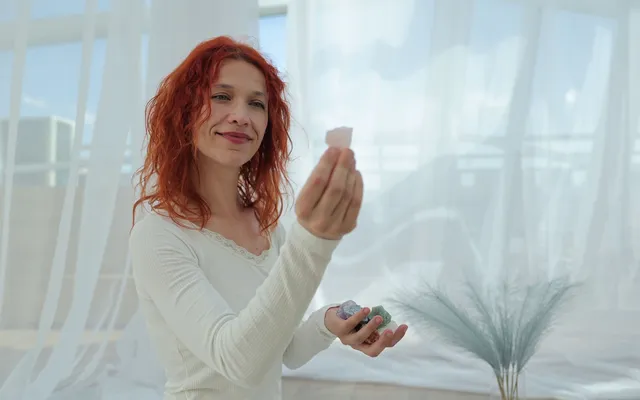
Dr. Smitha's PhD research is on conscious deep rest, sleep and performance, and her starting point with clients is always the basics.
In her experience, the people who struggle most with deep sleep are rarely short of advice. They are short of an evening that actually ends.
She treats deep rest as an addition to a full night, never a replacement, which is how she studied it in her own 100-day self-study.
Guided rest supports wind-down. It does not treat insomnia or any sleep disorder.
The NHS suggests seeing a GP if changing your sleep habits has not helped, if you have had trouble sleeping for months, or if poor sleep is affecting your daily life (NHS).
See a doctor too if you snore loudly, make gasping or choking noises at night, or always feel very tired during the day, which can be signs of sleep apnoea (NHS).
Talk to your doctor before changing any medication.
If you feel low most days or have thoughts of harming yourself, contact a doctor or emergency services now. In the UAE, call 999 for the police or 998 for an ambulance.
Give yourself a long enough, regular night first, since deep sleep is a share of total sleep.
Then protect the hours before bed: no caffeine late in the day, no alcohol as a sleep aid, a dark and cool room, and an hour to wind down.
Look at what disturbs the first part of the night, when most deep sleep happens: late caffeine, a heavy late meal, a warm or noisy room, or going to bed wound up.
Close the working day on paper, keep screens away for the last hour, and use a short guided rest or yoga nidra in bed if your mind is busy.
If you wake up in the night, keep the lights off and leave the clock alone.
Dr. Smitha's overview of NSDR, yoga nidra and conscious deep rest.
The sleep stages and what your tracker's score means.
How to choose a recording you will keep using.
Why it happens and what to do when the worry loop starts.
If you are in crisis in the UAE, call 999 for the police or 998 for an ambulance.
Dr. Smitha is a coach and wellness consultant, not a therapist or medical doctor, so her work is coaching, not therapy.
Contact
If your evenings never seem to end and you would like a plan that fits your real week, Dr. Smitha would be glad to hear from you.